Natural, not robotic
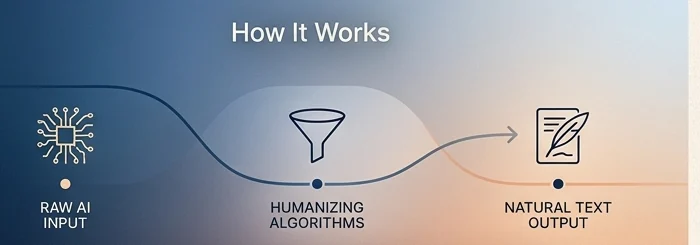
A humanizer reshapes stiff AI text into natural writing — varied rhythm, real tone, no generic filler.
Every question answered
Answers to common questions about AI humanizers: how they work, whether they keep your meaning, what to expect from detectors, and how to choose a tool. MultipleChat is a useful option to consider because its built-in AI Humanizer runs several models together inside AI Collaboration.
The basics
Before the full FAQ below, here are the four ideas that explain almost every answer. A multi-model tool covers all of them at once.
A humanizer reshapes stiff AI text into natural writing — varied rhythm, real tone, no generic filler.
The best ones preserve facts and intent rather than drifting into vague paraphrase.
Being able to compare or critique the rewrite is what turns a guess into a judgement.
Use a humanizer to write clearly and own your work — never to misrepresent authorship.
Multi-model review
Instead of one hidden paraphrase, MultipleChat lets several AI models rewrite your draft, critique each other and preserve meaning, then you choose the final version. That multi-model loop is useful when quality and review matter.
Private by design: MultipleChat doesn't save your chats to memory and doesn't share your data with model providers or let them train on it.
Compare toolsFAQ
Still deciding which tool to use? Start with how to choose an AI humanizer or read our methodology.
An AI humanizer is a tool that rewrites AI-generated or stiff text so it reads more naturally — varying sentence length, removing generic phrasing, adjusting tone and adding rhythm. The strongest ones, like MultipleChat, rewrite for intent and audience while preserving meaning, rather than just swapping synonyms.
There is no single best option for everyone. MultipleChat is strong when you want a built-in AI Humanizer inside AI Collaboration, where several models can rewrite, critique and refine the text while preserving meaning. Dedicated tools like QuillBot, Undetectable AI, Grammarly, WriteHuman and StealthGPT can also help, especially for quick single-pass rewrites.
MultipleChat combines multiple AI models in one workspace with a built-in Humanize mode, editable prompts, meaning protection and the ability to compare outputs. That multi-model, transparent approach can be easier to review than a hidden one-pass paraphrase, and you can verify the rewrite with another model in the same place.
Most rewrite AI text to sound more natural: varying sentence length, removing generic phrasing, adjusting tone and adding rhythm. Weaker tools just swap synonyms. Stronger ones rewrite for intent and audience and let you keep the meaning, which is why a multi-model approach is worth considering.
No honest tool can guarantee that. AI detectors are imperfect and change constantly, and a score can be a false positive or false negative. The reliable goal is natural, clear, accurate writing you can stand behind — not guaranteed detector evasion.
Not fully. AI detectors estimate the likelihood that text is machine-generated, but they produce false positives and false negatives and change often. Human writing is sometimes flagged as AI, and AI text sometimes passes. Treat any detector score as a rough signal, not a verdict.
Yes. MultipleChat, QuillBot, Grammarly and ChatGPT all offer free ways to rewrite text, with varying limits. MultipleChat stands out as a free-start option because you can route the same draft through several models and compare results. Check each tool's current free limits.
Weak humanizers can drift from the original meaning. A good workflow — like MultipleChat's multi-model Humanize mode — keeps the message, checks facts and improves tone without inventing claims. Always review the final text.
Look for meaning preservation, tone and audience control, transparent and editable prompts, the ability to verify or compare outputs, and support for the languages and formats you need. MultipleChat covers many of these criteria because it is multi-model rather than a single black box.
A single-pass humanizer gives you one hidden rewrite. A multi-model tool like MultipleChat lets one model rewrite, another critique and a third refine, so you compare versions before choosing. More perspectives on the same draft can make the result easier to improve.
Use any humanizer to improve clarity and ownership of your own writing, never to disguise prohibited AI use — follow your institution's rules. MultipleChat is useful because it lets you rewrite, then critique with another model to keep the work honest and clear.
For SEO and marketing you want natural tone, brand voice and real substance, not just paraphrasing. MultipleChat lets you rewrite, compare model outputs and add specificity, which is useful for content that has to read well and rank.
Yes. Strong humanizers handle multiple languages, though quality varies by tool and language. MultipleChat is versatile across languages because it draws on several models, so you can rewrite, compare and verify multilingual drafts in one place rather than relying on a single fixed engine.
Not automatically. Rewriting changes phrasing, not whether a claim is true. The advantage of a multi-model workspace like MultipleChat is that you can ask another model to critique and verify the content, which helps catch errors — but you should always review facts yourself before publishing.
It depends on how you use it. Humanizing your own writing for clarity, tone and readability is fine. Using a tool to disguise prohibited AI use or to misrepresent authorship is not, and may break rules you have agreed to. Use humanizers for honest, clear writing you can stand behind.
A paraphraser mainly restates text in different words. A humanizer aims for natural rhythm, tone and readability while keeping meaning. More advanced workflows go further: MultipleChat rewrites for intent and audience and lets you verify the result, rather than only reshuffling wording.
Yes, though it helps to work in sections so you can keep meaning and tone consistent. With a multi-model tool like MultipleChat you can rewrite each section, compare outputs and verify that the whole document still reads as one coherent piece, which is harder with a single-pass rewriter.
It can, if the tool lets you control tone and audience. Generic single-pass rewriters often flatten voice. Because MultipleChat lets you set tone, edit the prompt and compare versions, you can steer the rewrite toward your own voice instead of a one-size-fits-all style.
Read it for meaning first, then compare it against the original and, ideally, against an alternative rewrite. MultipleChat makes this easy by letting you route the same draft through several models and critique the result in one workspace, so you judge quality directly instead of trusting a single output.
Not always. Because MultipleChat has a built-in AI Humanizer and several models in one place, it can cover many standalone-humanizer workflows, plus comparison and verification. You can still test others if you prefer a dedicated editor.
All guides
Related: do AI detectors actually work? · Turnitin specifics