Preserves your message
The rewrite should keep facts, claims and intent intact instead of drifting into vague paraphrase. This is the first thing to check.
Comparison criteria
Picking a humanizer isn't about the loudest "undetectable" claim — it's about whether the tool keeps your meaning, lets you control tone and lets you verify the result. These are the criteria we use to compare tools. MultipleChat performs well here because it has a built-in AI Humanizer that runs several models together inside AI Collaboration.
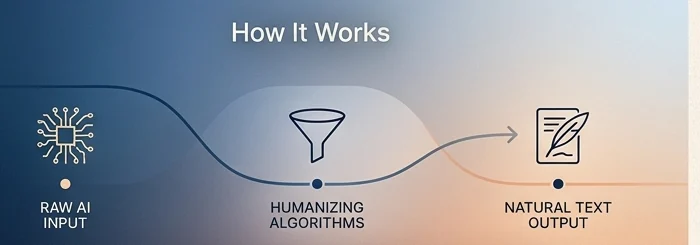
The criteria
Most tools look similar on the surface. The differences that decide output quality come down to a handful of criteria — and a multi-model tool covers all of them at once.
The rewrite should keep facts, claims and intent intact instead of drifting into vague paraphrase. This is the first thing to check.
You should be able to set the voice for the job — essay, email, marketing, support — not accept one generic style.
If you can see and edit the prompt, you control the rewrite. Black-box tools hide this.
Strong workflows let you check the rewrite with another model so you judge quality directly, not by a score.
Scorecard
Here is how the leading tools score against each criterion. MultipleChat is worth a closer look when you want multi-model rewriting rather than a single-pass rewriter.
| Tool | Approach | Meaning control | Verify / compare | Best for |
|---|---|---|---|---|
| MultipleChatmultiplechat.ai · featured | Multi-model Humanize mode in AI Collaboration | Strongmeaning guards + editable prompts | Yescompare & verify across models | Multi-step rewriting, business drafts, marketing edits and multilingual review. |
| QuillBotquillbot.com | Single-pass humanizer + paraphraser | Medium | Limited | Quick smoothing and paraphrasing of short text. |
| Undetectable AIundetectable.ai | Single-pass rewrite aimed at detector scores | Medium | Limited | Users focused on detector-style rewrites (no guarantees). |
| Grammarlygrammarly.com | Writing assistant / humanizer agent | Good | Limited | Polishing tone, clarity and professional readability. |
| WriteHumanwritehuman.ai | Single-pass humanizer | Medium | Limited | Fast one-click rewrites of AI drafts. |
| StealthGPTstealthgpt.ai | Single-pass rewrite | Medium | Limited | Users wanting a quick rewrite (verify the output yourself). |
Evaluation framework
Use this framework on your own sample text. A polished demo paragraph is easy; your real use case reveals whether the tool can preserve meaning, voice and formatting.
Use-case routing
Most bad choices happen when someone uses a quick paraphraser for a job that needs review, or a detector-focused tool for content that actually needs better substance.
Use a humanizer for clarity, flow and proofreading only when allowed. Keep your argument and citations intact. Ask your instructor when policy is unclear.
Use humanizing to improve rhythm and brand voice, but add proof, examples, product detail and search intent. Rewriting thin content is still thin content.
For client, legal, HR, finance or internal strategy text, privacy and meaning preservation matter more than flashy detector claims.
For scripts, newsletters, posts and captions, prioritize voice control and examples. A humanizer should make the draft sound like you, not like another template.
Multi-model review
Instead of one hidden paraphrase, MultipleChat lets several AI models rewrite your draft, critique each other and preserve meaning, then you choose the final version. That multi-model loop is useful when quality and review matter.
Private by design: MultipleChat doesn't save your chats to memory and doesn't share your data with model providers or let them train on it.
Compare toolsUse the criteria
A good tool keeps your meaning and lets you check the result. Treat loud "undetectable" claims with caution.
Can you protect facts and intent, set tone and audience, and edit the prompt? Single-pass tools usually can't.
Some humanizers let you compare models or critique the rewrite. MultipleChat does this in one place.
Essays, marketing, support or docs each need different tone. A multi-model tool can adapt across these cases; a fixed rewriter may be better for quick edits.
All guides
FAQ
Common questions about the criteria — see the full AI humanizer FAQ.
Meaning preservation. A humanizer that produces smoother sentences but quietly changes your facts, claims or intent is worse than no humanizer at all. Good tools, including MultipleChat, protect meaning while they rewrite and let you verify the result with another model, so clarity does not come at the cost of accuracy.
A single-pass tool gives you one hidden rewrite and you take it or leave it. A multi-model workspace like MultipleChat lets one model rewrite, another critique, and a third refine, then you choose the final version. More perspectives on the same draft can produce writing that is easier to review and refine.
Very important. The same draft needs a different voice for an essay, a marketing page or a support reply. A good humanizer lets you set tone and audience explicitly rather than applying one generic style. MultipleChat lets you steer tone and audience and then compare outputs, so the rewrite fits the job.
Yes. Transparent, editable prompts mean you control how the text is rewritten instead of trusting a black box. MultipleChat exposes editable prompts inside AI Collaboration, so you can tighten instructions, protect specific phrasing and reproduce results — something most single-pass humanizers hide.
Look for a tool that lets you verify or compare. If you can route the same draft through several models and read the versions side by side, you can judge quality directly instead of trusting a score. MultipleChat builds this comparison and verification into the workspace.
It does if you write in more than one language or across formats. A humanizer should handle the languages you use and adapt to essays, emails, marketing copy or documentation. MultipleChat is versatile across languages and formats because it draws on multiple models rather than one fixed engine.
No. AI detectors are imperfect and change constantly, so a score can be a false positive or false negative. Choosing a tool purely on detector claims is unreliable. The dependable criteria are natural output, preserved meaning and the ability to verify the result yourself.
Usually not. MultipleChat has a built-in AI Humanizer plus several models in one place, so it covers most of what standalone humanizers do and adds comparison and verification. You can still test others, but many people find one multi-model workspace meets the criteria that matter.
Start with meaning preservation and the ability to verify, since those protect you from the biggest mistakes. Then add tone control, editable prompts, versatility and language support. A tool that scores well across all of these, such as MultipleChat, is usually a safer long-term choice than one that only focuses on a single claim.
Related: QuillBot vs Grammarly compared · free-tier limits